under the hood · 2026-07-30 · 1 min
Under the Hood: The Sideline Board
I coach 3rd/4th-grade soccer. I asked my OS for a tool that guarantees equal playing time and works with zero connectivity at the field. The constraints did the designing.
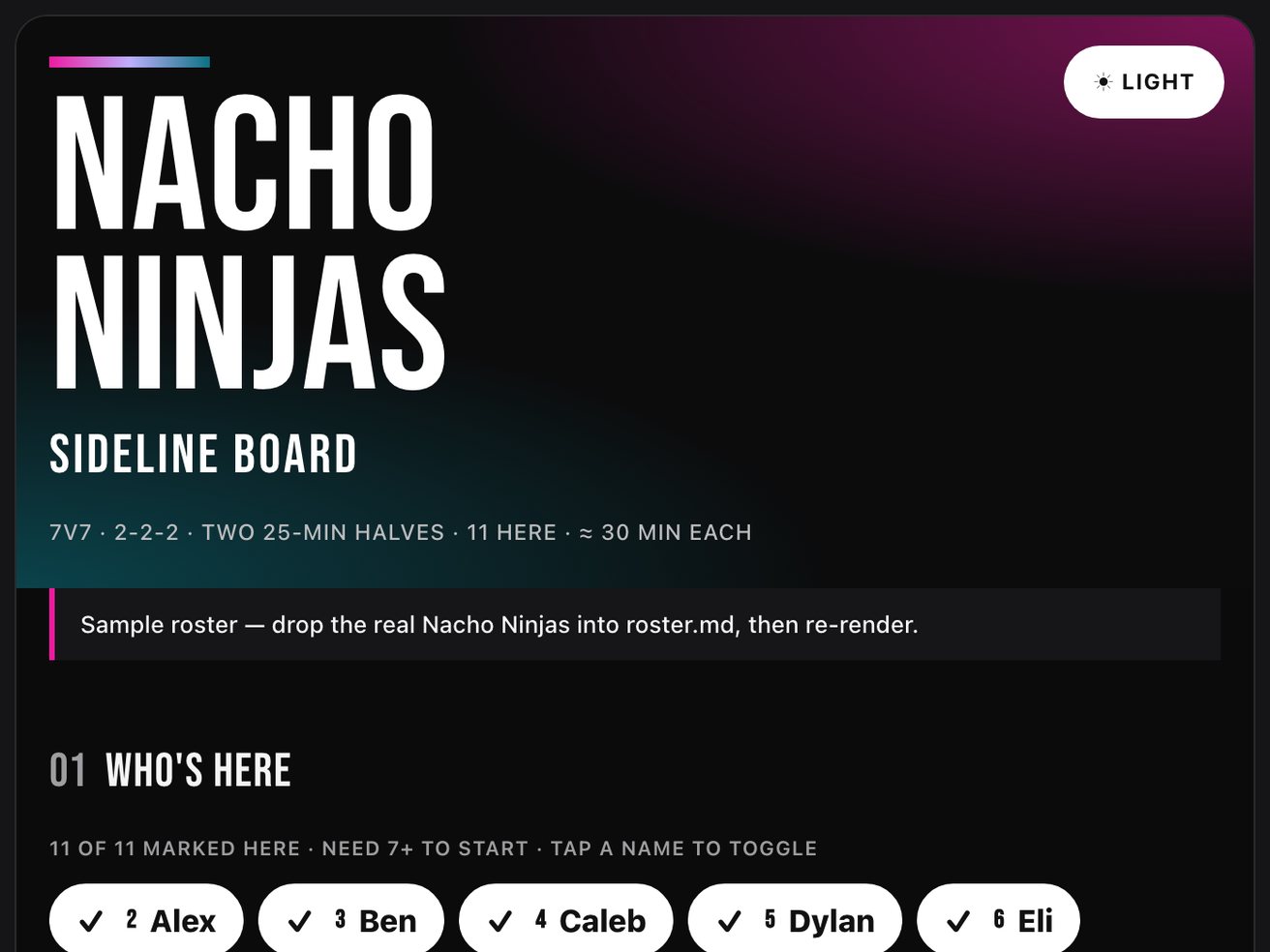
I coach a 7v7 rec team — the Nacho Ninjas, 3rd and 4th graders, two 25-minute halves. Every rec coach knows the real problem isn't tactics: it's making sure every kid plays a fair share while you're also refereeing snack disputes.
The brief was three constraints
Not features — constraints. Equal playing time, verifiable, not vibes. Works at a field with no signal. Operable with one thumb while watching a game. I told the OS what had to be true and let the design fall out of that.
What came back, and what we refined
The first output was a lineup engine plus a tap-to-sub board. The engine got tested against the thing that actually matters: it schedules every present player to within one five-minute window of equal time, and that's verified in the data, not asserted — the roster lives in a markdown file, a render script produces the board, and the math is checkable.
The offline constraint shaped everything visual. No web fonts you can't guarantee — the display face is embedded straight into the file so the board opens from a phone's files app with airplane mode on. Giant condensed type, because sideline legibility in sunlight is a real requirement, not an aesthetic.
One governance detail I'm stubborn about: the board still runs on a sample roster. Real kids' names don't go into a system until I put them there deliberately — the tool ships gated, marked clearly, waiting for me. That's the same rule my job-search and finance agents follow: the human loads the sensitive data, never the machine by default.
Why this is on a design portfolio
Because it's the shape of every good AI collaboration I've had: the human brings constraints that are actually true about the world, the system proposes, the output gets verified against the constraint rather than admired. A pretty board that shorted some kid four minutes would be a failure. This one can prove it doesn't.