The End of the Second Brain: Why I’m Building an Agentic Operating System
The future isn’t knowledge management. It’s autonomous execution.
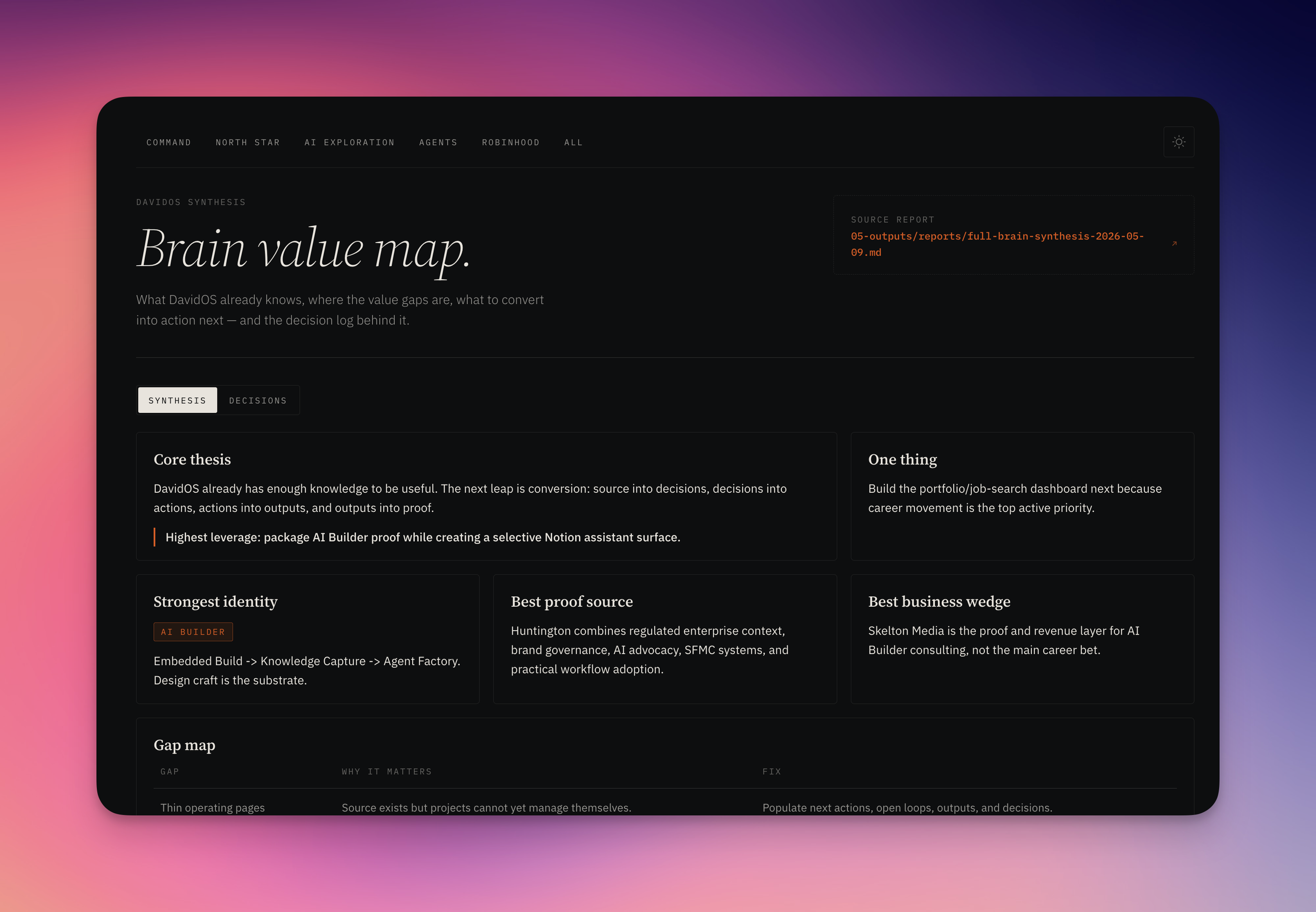
I stopped trying to write a perfect personal wiki and built a local agentic factory instead. I was inspired by computer scientist Andrej Karpathy's concept of a personal wiki—a highly structured, plain-text vault to record projects, memories, and learnings. But I ran into a universal wall: manual wikis are time capsules that begin decaying the moment you stop writing. They require constant, tedious maintenance. The breakthrough came when I stopped treating my vault as a static filing cabinet and started treating it as a local database for AI agents. By combining local files with simple scripts, I turned a passive wiki into a live, agent-driven operating system. I no longer pay for expensive SaaS automation subscriptions. I use AI to build my own tools, paying only for the raw API tokens I consume.
The Evolution: From Passive Wiki to Active OS
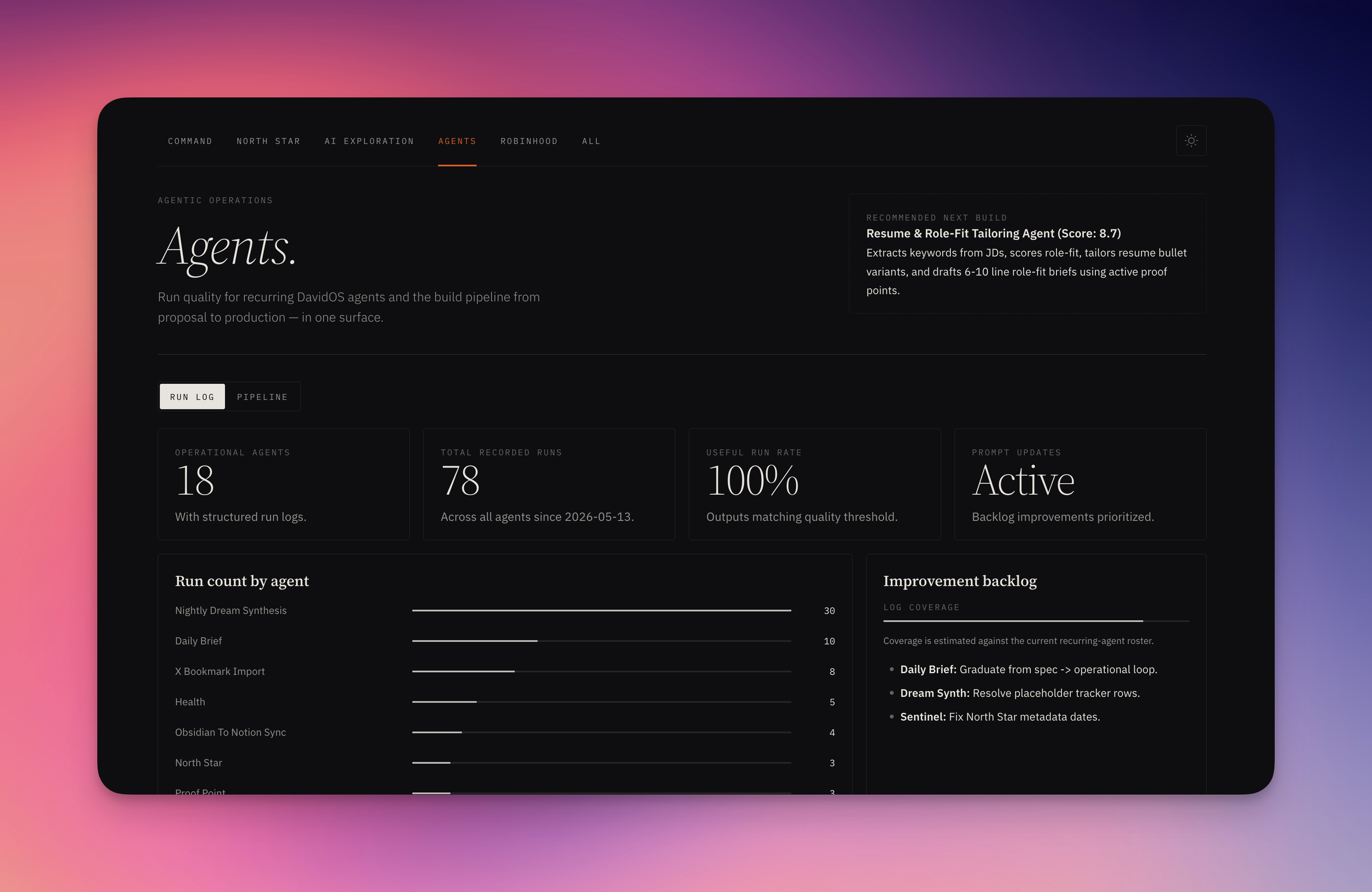
A wiki is a passive archive of what happened; a business OS is an active colleague. My system, DavidOS, runs locally in a plain-text markdown vault. It started as a clean way to organize my product design work, but it quickly evolved. Instead of renting database connectors or paying for tools like Zapier, Airtable, or Notion AI, I wrote simple python scripts to coordinate my operations. One script syncs my Google Calendar directly into my local files. Another scans my daily logs for recurring operational blockers.
Every night, a local agent runs a "Dream Synthesis" pass. It reads my day's outputs, connects emerging ideas across my projects, updates my active checklists, and generates the data that runs my desktop dashboard. I do not store my business intelligence inside a vendor’s cloud. The files stay on my drive. The AI is simply a utility that runs against those files. If I want to change AI providers tomorrow, I do not have to migrate databases or rebuild workflows. I change a single adapter line in my code.
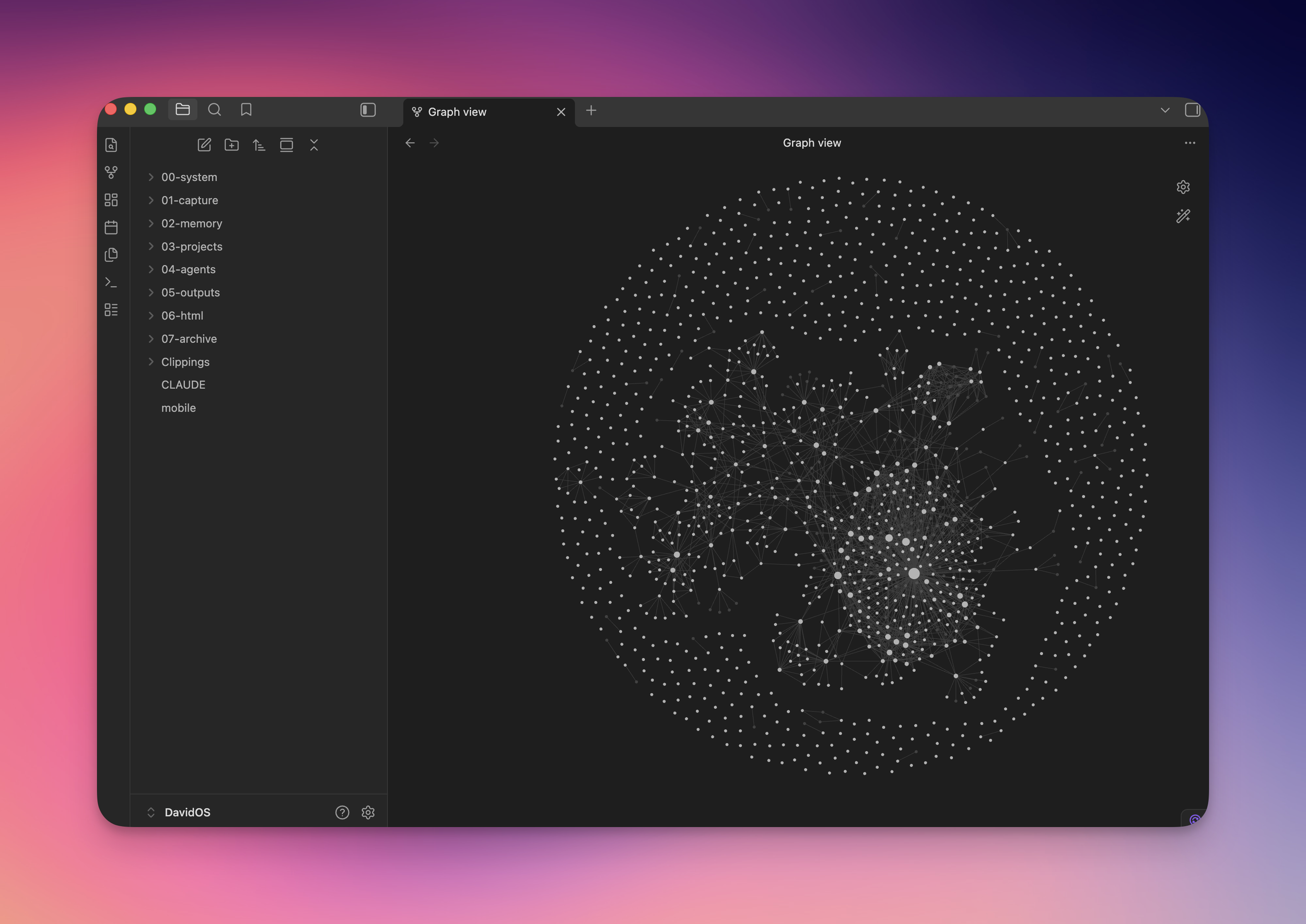
In DavidOS, knowledge is the raw material. Obsidian serves as the local-first memory layer where ideas, decisions, projects, and operational context are connected into a living graph. Agents use that graph to transform information into actions, workflows, and outcomes.
The Key Substrate: Brand as Code
You cannot automate workflow execution if your AI does not know what your brand values look like. This is where most enterprise AI implementations fail. Companies dump PDFs of brand guidelines and styling rules into a vector database and expect the AI to write compliant code or design beautiful layouts. It doesn't work. The AI lacks the guardrails to execute consistently.
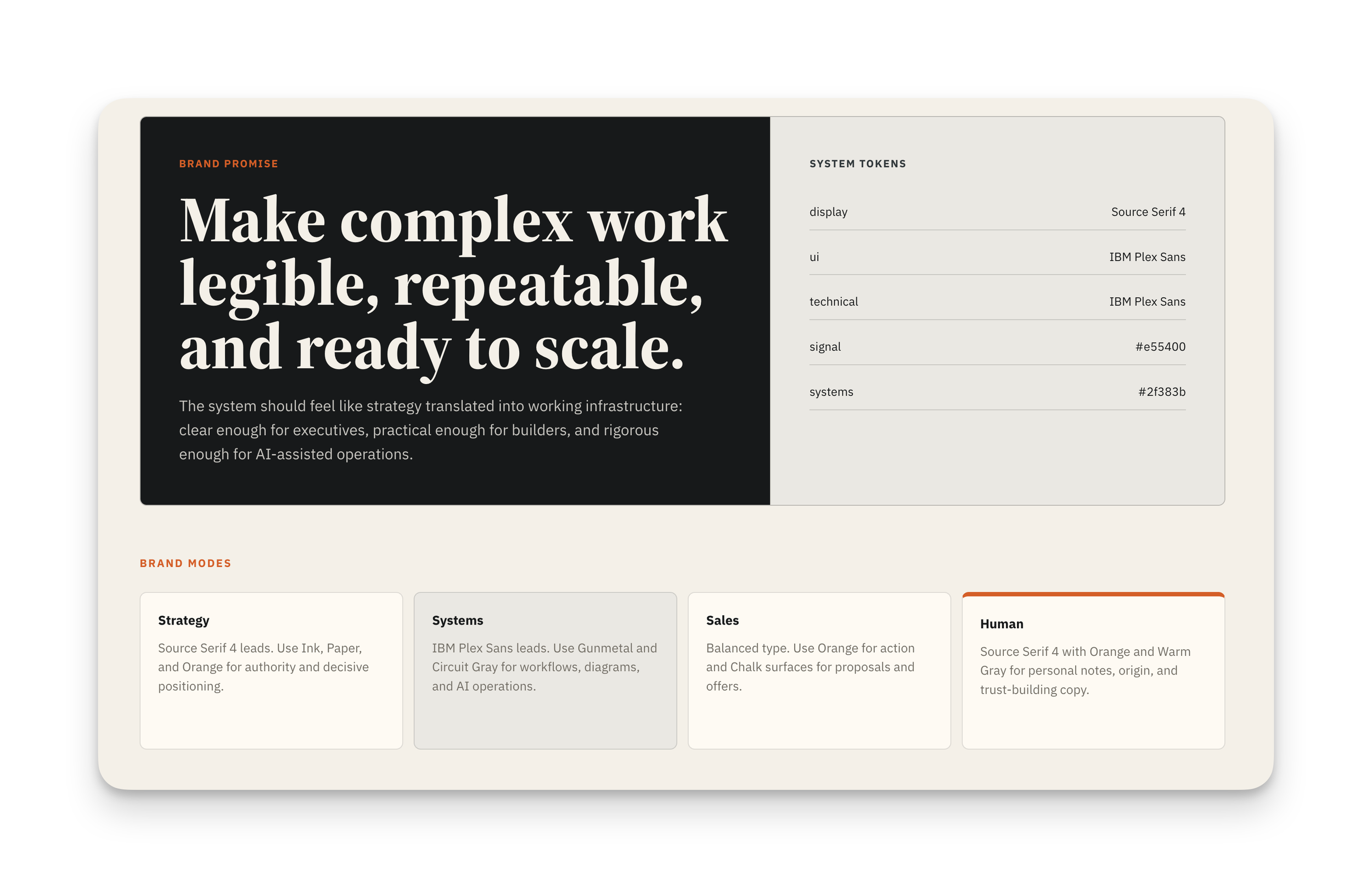
To solve this, I built a framework called Brand as Code. I translate visual guidelines, Figma layouts, typography scales, and compliance constraints into structured markdown files, JSON design tokens, and cascading rule files. When my custom agents build marketing assets—like the Figma-to-HTML Email Agent I designed—they are not guessing the style. They are executing code rules. The agent reads the brand tokens directly from the local file system. It generates production-ready, ADA-compliant code that matches the brand standard perfectly on the first run. The system enforces brand governance automatically, reducing manual review time from days to hours.
The future isn’t better documentation. It’s operational intelligence.
We’re moving from static playbooks and knowledge bases to systems that can understand, coordinate, and execute work.
The Results: Owning the Context
When you build your own tools on a local file system, your business context compounds instead of fragmenting. The outputs are what convinced me. Personalized client proposals written in my voice on the first draft. Brand-aligned case studies pulled from real project history. Agents that catch formatting errors before they hit production. A daily brief every morning that already knows what's in motion, what's stalled, and what needs a decision. None of it generic. All of it shaped by the files I've been adding for months. By replacing expensive SaaS tools with local scripts and custom agents, I cut my software overhead in half. Because my dashboards run locally, page loads are instantaneous. I have zero platform lock-in.
More importantly, the quality of my work has improved. Because every project brief, client proposal, design token, and system log is stored in a clean, structured directory, my AI agents have access to perfect context. They write highly personalized client proposals, draft brand-aligned case studies, and catch formatting errors in staging folders before they can hit production. The database grows more valuable with every file I add.
The system doesn't just store work — it learns the shape of your work. Every client brief you save teaches it your language. Every proposal that closes becomes a pattern it can repeat. Every failed pitch is a data point that quietly adjusts what it suggests next time.
What starts as a folder structure becomes something closer to institutional memory. The agents stop feeling like tools and start feeling like colleagues who've been here from the beginning — ones who remember the client who always wants three rounds of revisions, the project type that stalls in week two, the brand voice that took six drafts to nail. They hold all of that without being asked.
As the business grows, the system grows with it. Add a new client vertical and the relevant templates, tone references, and past work surface automatically in that context. Spin up a new service offering and the directory already knows where to file the proposals, the contracts, the case studies. The architecture scales not because you planned for scale, but because structure compounds.
The most useful thing about a system like this isn't what it does today. It's that it's always slightly ahead of you — flagging the proposal that hasn't had a follow-up, noticing the client brief that contradicts a decision from six months ago, surfacing a proof point you forgot you had right when you need it for a pitch. You don't have to remember everything. The system does.
The Takeaway
Stop renting software that forces you to adapt to its structure. If you are running a business, you do not need another monthly subscription to a tool that isolates your data. You need to own your context. You need a clean, structured folder architecture and the ability to build lightweight agents that run against it. When you turn your files into a local-first operating system, your data compounds, your tools cost pennies, and your workflows adapt to your exact operations.
If you are tired of fragmented databases and want to explore how to build a compounding, compliance-aware AI workspace or a custom Brand as Code pipeline for your business, let's talk.
What does the biggest bottleneck in your team's current daily workflow look like, and how much time could you save if you had a custom tool built specifically to eliminate it? Let's discuss what we might build together.